SOIC-8 Clip
Spring-loaded test clip that grips the eight legs of a SOIC-8 chip so you can read an SPI flash or I2C EEPROM in-circuit, without desoldering it.
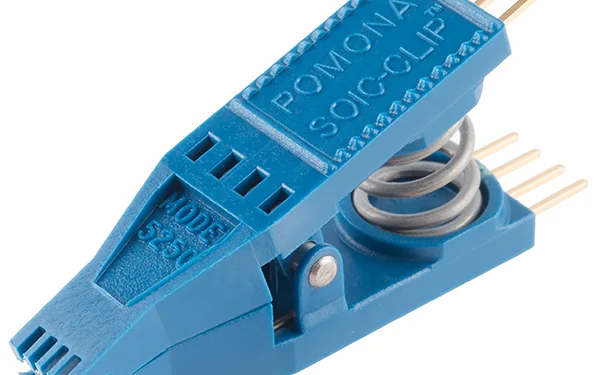
A SOIC-8 clip is a spring-loaded test clip whose jaws carry eight sprung contacts that grip the legs of a SOIC-8 chip. It lets you tap an SPI flash or I2C EEPROM in-circuit, reading it in place without desoldering. The blue Pomona 5250 pictured is the reference part; cheaper clones exist and work, if less reliably.
What it is
The clip is a plastic clothespin with eight gold-plated pins in each jaw, sprung so they press onto a SOIC-8 chip's gullwing leads when you squeeze it open and release. A ribbon or a set of Dupont wires brings those eight contacts out to a programmer. "SOIC-8" refers to the 8-lead Small-Outline IC package (typically 1.27 mm pitch); a wider SOIC-16 or a narrower TSSOP needs a different clip. The clip is purely a mechanical connector: it carries whatever signals the chip and programmer use, SPI or I2C alike.
Why it matters
Firmware usually lives in a SOIC-8 SPI NOR flash, and config often lives in a SOIC-8 or DIP-8 EEPROM. A clip lets you connect a programmer to the chip's pins where they sit on the board, dump the image with flashrom, and analyse it offline. That is the fastest non-destructive route to a device's firmware: no hot air, no reballing, and the board still works afterwards. When a clip will not seat (chip too close to a shield or an inductor), the fallback is desoldering, which is slower and riskier.
How to use it
- Find pin 1. A dot, a dimple, or a bevelled edge on the chip marks pin 1.
- Orient the clip. The pin-1 lead is usually the red wire. Line it up with chip pin 1 (see the diagram; get this wrong and VCC/GND swap).
- Seat it square. Clip on so all eight sprung contacts land on the eight legs, not skewed by one position. A magnifier helps.
- Read twice and compare. A poor contact produces a plausible-looking but corrupt dump.
flashrom -p ch341a_spi -r r1.bin
flashrom -p ch341a_spi -r r2.bin
sha256sum r1.bin r2.bin      # the two reads must match
If the hashes differ, the clip is seated poorly or the board's CPU is contending for the bus. Powering the board down, holding the SoC in reset, or lifting the flash's power pin usually fixes it.
Pitfalls
- Pin 1 orientation. The commonest and most expensive mistake. A rotated clip feeds VCC into GND and can destroy the chip instantly. Confirm the pin-1 corner before you power anything.
- Contact quality. Fine-pitch legs, flux residue, or a slightly bent contact give an intermittent read. Reseat, clean the legs, and lower the SPI clock.
- Bus contention. In-circuit, the host CPU may also drive the flash. Cut its power or hold it in reset so only the programmer talks to the chip.
- Package match. A SOIC-8 clip does not fit a WSON/QFN leadless package (no legs to grip). Those need a socket adapter or desoldering.
Further reading
Used in these courses
You have a firmware blob. What now? This course teaches the complete analysis workflow: identify the format, extract the filesystem, explore the structure, and find what matters. Every IoT device has firmware - this is how you read it.
Wired Chip Access: SPI Flash and JTAG**Beginner** probe lab. Wired-bus tradecraft with the probe CLI against two intro boxes: a block-protected SPI NOR flash and a JTAG-locked microcontroller. Model B: bring your own probe CLI, flags travel over the wire.