Chip Packages (SOIC, QFN, BGA)
How a chip is mounted decides whether you clip it, hot-air it, or reball it. Reading the package sets your whole toolchain before you attempt to dump or probe the part.
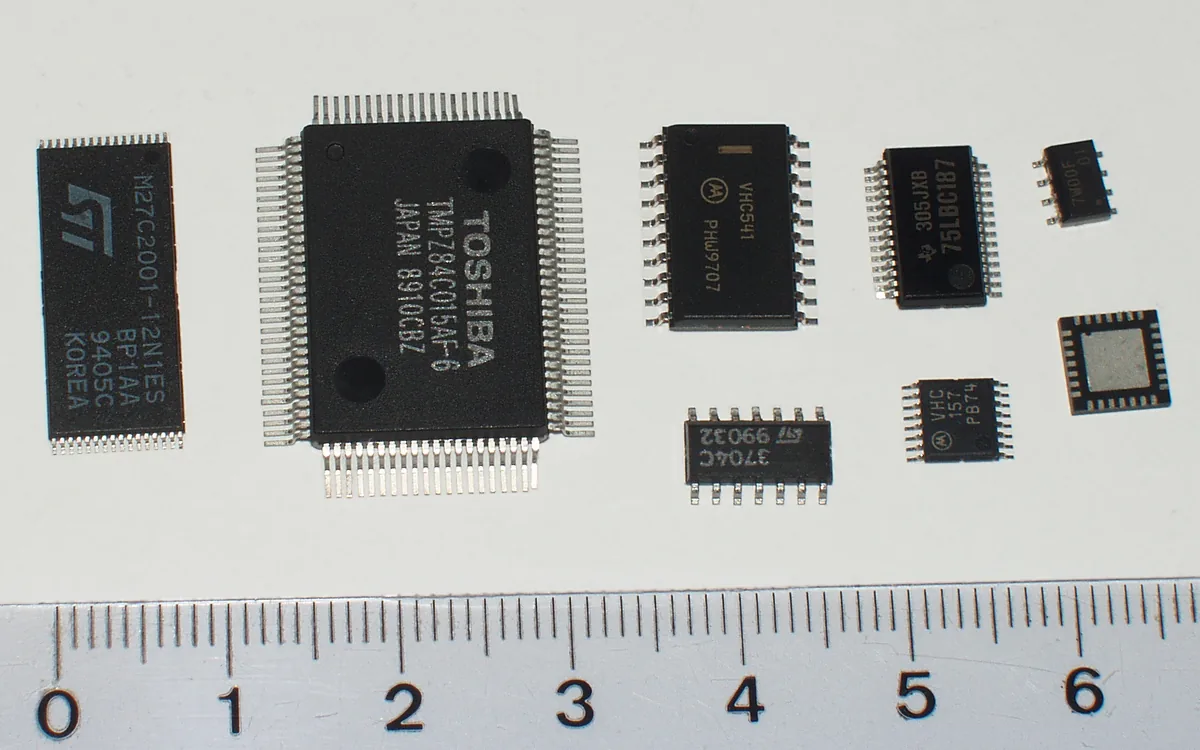
A chip package is the physical housing and lead layout of an integrated circuit. It decides, more than anything else, how much effort it takes to read that chip: a package you can clip is a five-minute job, a package with hidden balls is a soldering-station afternoon. Recognising the package on sight tells you which tools you will need before you commit.
What it is
The die inside is tiny; the package exists to fan its pads out to something a board (or a clip) can connect to. Packages sort into three families by how they present their contacts, from easiest to hardest to reach (see the diagram):
| Package | Leads | Access |
|---|---|---|
| SOIC / SOP | Gull-wing, on two sides, visible | Test clip, read in-circuit, easy |
| TSSOP / SSOP | Fine-pitch gull-wing | Clip if pitch allows, else hot air |
| QFP / TQFP | Gull-wing on all four sides | Fine pitch, probe or hot air |
| QFN / DFN | Pads under the body, thin edge | Probe the edge or hot-air off, harder |
| BGA / CSP | Solder balls under the body | Fully hidden, remove and reball |
Why it matters
The package sets the toolchain. A leaded SOIC-8 SPI flash is the friendliest target on the bench: a soic8-clip grabs it in place and a ch341a reads it in seconds, no desoldering. A QFN has no legs to clip, so you either land probes on the thin side pads or hot-air the chip off the board to read it in a socket. A BGA hides every contact as a ball underneath, so there is no probing it at all: you remove it with hot air, then reball and socket it, or attack the board another way. Spot the package first and you know instantly whether this is a clip job or a rework job.
How you work with one
- Read the markings. Note the part number and use the datasheet to confirm the exact package variant and the pin-1 marker (a dot or bevelled corner).
- SOIC/SOP: clip a
soic8-clipstraight onto the legs and read in-circuit withflashromor ach341a; power isolation may be needed if the board back-powers. - QFN/DFN: try edge-probing the exposed pad tips; if that fails, hot-air the part off and read it in a matching socket adapter.
- BGA: hot-air removal, then reball or drop it into a BGA socket; this is the highest-effort path and risks the die.
Pitfalls
- In-circuit reads fight the board. Clipping a live SOIC flash can back-power the whole board and corrupt the read; you may need to hold the host CPU in reset or lift a power pin.
- Fine pitch defeats cheap clips. A generic SOIC clip will not reliably land on a 0.4 mm-pitch TSSOP; wrong contact gives garbage, not an error.
- Hot air kills neighbours. Reworking a QFN or BGA reflows nearby components and can lift small parts; shield them and mind the temperature profile.
- Pin 1 mistakes are silent. Rotate the package wrong and every pin maps to the wrong signal; always find the pin-1 marker and cross-check against the datasheet before reading.