Antenna
The transition between a wave guided in a cable and a wave travelling in space. Its length follows the wavelength, its gain is redistribution rather than amplification, and it is the cheapest variable in every capture that fails.
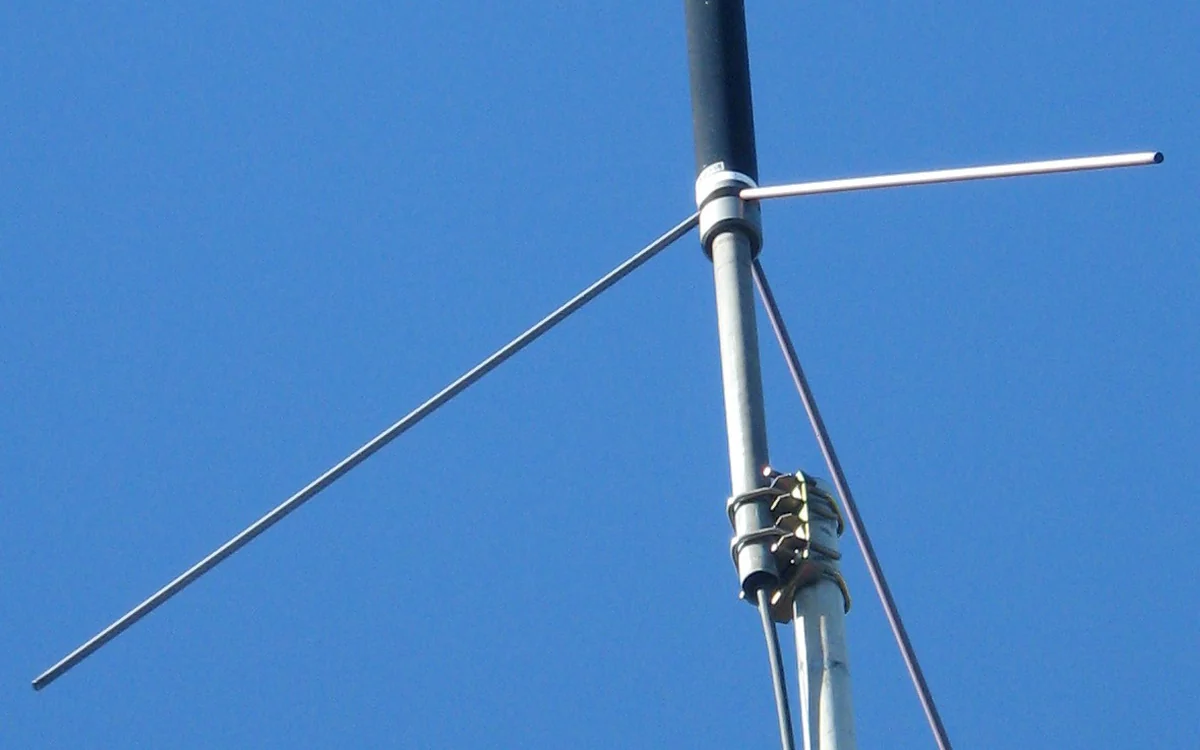
An antenna is the transition between a wave guided inside a cable and a wave travelling freely in space. It is a passive piece of metal, it adds no energy, and it is nonetheless the single most effective thing you can change when a capture fails. It also works identically in both directions: an antenna that transmits well in a direction receives well from that direction, which is reciprocity.
Resonance and length
An antenna radiates efficiently when its length matches the wave it is trying to launch. The reference case is the half-wave dipole: two quarter-wave arms fed in the middle, current maximum at the feed, zero at the tips, and about 73 ohm at its feed point. Cut it in half and stand it on a ground plane and you have the quarter-wave monopole, the whip on your dongle: the ground plane supplies the missing half as a mirror image, and the feed impedance drops to roughly 36 ohm with flat radials.
A wave travels slightly slower in a wire than in space, so multiply the theoretical length by a velocity factor of about 0.95 as a starting point:
| Band | Quarter-wave cut length |
|---|---|
| 137.5 MHz (weather satellites) | 51.8 cm |
| 433.92 MHz (ISM remotes) | 16.4 cm |
| 868 MHz (EU ISM) | 8.2 cm |
| 1090 MHz (ADS-B) | 6.5 cm |
| 2437 MHz (WiFi channel 6) | 2.9 cm |
Length is electrical, not physical: the 16.4 cm whip that is a perfect quarter wave at 434 MHz is a half wave at 868 MHz, where the feed impedance goes through the roof, and 226 electrical degrees at 1090 MHz, where the pattern breaks into lobes.
Gain, pattern and nulls
An antenna does not create power, it redistributes it. Antenna gain, quoted in dBi, is the ratio between the power density it produces in its best direction and the power density an isotropic radiator would produce with the same input, so 0 dBi is the isotropic reference and a half-wave dipole is 2.15 dBi (a directivity of 1.64). A Yagi at about 11 dBi has simply traded almost every other direction for one.
The radiation pattern is where that power went, and its nulls matter as much as its lobe: a vertical dipole radiates broadside and has deep nulls straight off the ends of the wire, which is exactly why a vertical whip is poor at hearing a satellite directly overhead.
Polarisation
Polarisation is the direction the electric field points, and it is set by the physical orientation of the antenna. Two linear antennas at an angle lose 20 log10(cos angle): nothing at 0 degrees, 3 dB at 45, 6 dB at 60, and in principle everything at 90. Circular polarisation costs a fixed 3 dB against a linear antenna, which is why satellites use it (a tumbling or rotating geometry would otherwise fade in and out) and why a vertical whip is the wrong tool for a weather satellite pass.
Matching and SWR
The radio, the coax and the antenna all want to agree on 50 ohm. When they do not, part of the wave is reflected at the antenna, and the size of that reflection is the reflection coefficient; the reflected wave adds with the forward one into a standing wave along the cable. SWR is the ratio between the peaks and the troughs of that pattern, and return loss is the same information in dB. The practical cost is smaller than the internet claims: an SWR of 2 to 1 loses about 0.51 dB. A missing ground plane is therefore not primarily an SWR problem, it is a pattern problem.
Pitfalls
- The antenna that came in the box is rarely cut for your band. A generic "SDR whip" at 137 MHz is a fraction of a quarter wave and can cost you more than every other term in the link budget combined.
- Orientation before hardware. Polarisation mismatch and a null pointed at the target routinely cost 6 to 20 dB, more than any realistic upgrade buys back.
- Chasing SWR. Under about 2 to 1 the loss is negligible; a low SWR also does not prove the antenna radiates, since a dummy load has a perfect SWR and radiates nothing.
- Feedline and connectors count. Thin coax at high frequency and a pile of adapters can swallow the gain you just paid for, and a low-noise amplifier belongs at the antenna, not at the radio.
Further reading
Used in these courses
**Beginner.** The last piece of hardware before the connector: cut a dipole or a quarter-wave for 137 to 1090 MHz, read a radiation pattern, and price polarisation mismatch and SWR in dB.
Decibels and Link Budget**Beginner.** Whether you can hear it at all: work in dB and dBm, compute path loss, noise floor and sensitivity, then run a real link budget and invert it for maximum range.
Waves and Spectrum**Beginner.** Where to tune and why anything is there: describe a wave with five numbers, place a service on the band map from 137 MHz to 2.4 GHz, and read an FFT.
Weather Satellite APT**Beginner.** Turn a 137 MHz NOAA pass back into a picture: detect the envelope of a 2400 Hz subcarrier, find the lines by correlating the sync trains, and measure the capture's true line period.